

Fun Jewelry: 2026 Guide to Unique Handmade Earrings
Table of Contents
- What Makes Fun Jewelry Different From Everyday Accessories
- Unique Handmade Earrings: Materials, Durability, and What to Look For
- How to Style Statement Jewelry Without Looking Overdone
- Artisan Jewelry Gift Ideas for Every Type of Person
- Hypoallergenic and Water-Safe: Choosing Fun Jewelry for Sensitive Skin
- Building a Curated Collection of Fun Jewelry That Lasts
- Conclusion
- Frequently Asked Questions
Last Updated: September 26, 2026
What Makes Fun Jewelry Different From Everyday Accessories
Fun jewelry is wearable art that prioritizes personality, color, and craftsmanship over convention. Unlike basic everyday accessories, these pieces are designed to start conversations and express who you are.
At Fernanda Design, we've watched this shift firsthand. Shoppers who once bought plain gold studs now hunt for quirky motifs, thematic collections, and artisan-inspired pieces that feel personal. The rise of independent designers has made it easier than ever to find something nobody else owns.
The difference comes down to intent. Everyday accessories blend in. Fun jewelry makes a statement, whether that's a pair of colorful polymer clay earrings or a bold pendant necklace with an unexpected shape.
The Rise of Quirky Motifs and Thematic Collections
Quirky motifs are the clearest signal that fun jewelry has moved mainstream. Think mushrooms, abstract shapes, tiny fruits, and celestial symbols rendered in resin or enamel.
Thematic collections take this further. A designer might build an entire capsule around ocean life or vintage botanicals, giving buyers a curated story instead of a random assortment. This approach appeals to art and design enthusiasts who value the narrative behind a piece.
For shoppers, the payoff is simple. You can build a small wardrobe of jewelry that feels intentional rather than scattered.
Unique Handmade Earrings: Materials, Durability, and What to Look For
Unique handmade earrings live or die by their materials. The three you'll see most often are polymer clay, resin, and enamel, and each behaves differently over time. Most sites stop at that sentence. Here's what actually happens when you wear them.
Polymer Clay, Resin, and Enamel: How Each Holds Up to Daily Wear
Durability questions come up constantly, and they're fair. A common mistake is assuming all handmade earrings are fragile. They aren't, provided you match the material to your routine.
- Polymer clay: Flexible and shock-resistant. Best for everyday wearable pairs, though extreme heat, think a hot car dashboard in summer, can soften it and cause warping.
- Resin: Hard and glossy. Keep it away from rough surfaces and it lasts for years, but it scratches more easily than enamel and can yellow over time with prolonged UV exposure. Store it out of direct sunlight.
- Enamel: Fired onto metal at high temperatures, so it resists chipping and tarnish better than painted finishes. A strong pick for statement pieces, though a hard drop onto tile can chip the enamel edge.
What Wear Testing Actually Reveals
A common pattern in wear testing is that failure points rarely come from the decorative material itself, they come from the findings. The hook, post, or jump ring is usually the first thing to go.
- Posts and backs: Gold-plated brass posts can lose their plating, exposing the base metal underneath. Sterling silver or 14k gold posts hold up far longer.
- Jump rings: Unsoldered jump rings can pull open under tension. Look for soldered rings on heavier pendants.
- Ear wires: Thin wire bends out of shape. A slightly thicker gauge holds its curve better over time.
When you shop, check the findings as carefully as the design, especially if you have sensitive skin. A beautiful clay earring on a cheap nickel post is still a cheap earring where it touches your body.
A Simple Longevity Checklist
Before you buy, run through these questions:
- What metal are the posts or hooks made of?
- Are the jump rings soldered or open?
- Is the finish sealed, or will it wear off with friction?
- Does the maker describe how to store and clean the piece?
Store each pair separately. Tossing them loose in a drawer is the fastest way to dull a finish. A soft pouch or a compartmented tray prevents the scratches that make resin and enamel look old before their time.
How to Style Statement Jewelry Without Looking Overdone
Most styling advice for bold jewelry stops at 'pick one focal point.' That's a starting rule, not a guide. Here's how to actually build outfits around fun pieces so they read as intentional rather than accidental.
The core principle is contrast through restraint. Let one piece lead and keep everything else quiet. Start with a neutral base, a plain tee, a simple dress, a monochrome outfit, then add your boldest piece, whether that's oversized huggie hoops or a chunky pendant necklace. The contrast does the work for you.
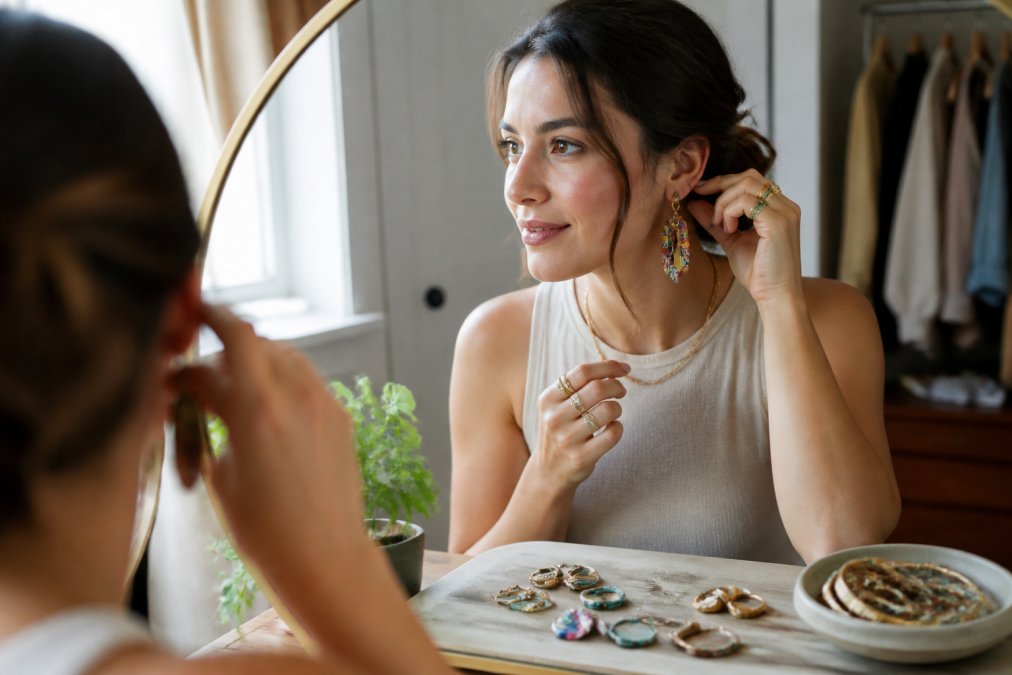
Styling by Aesthetic: Y2K, Cottagecore, and Cyberpunk
Curating by aesthetic rather than product type is the fastest way to make fun jewelry feel cohesive. Each look has its own material and color logic:
- Y2K: Think resin and enamel in candy colors, chunky plastic hoops, butterfly and star motifs, and layered necklaces with mixed metals. The rule is more-is-more, but keep the palette to two or three brights.
- Cottagecore: Polymer clay in earthy tones, mushroom and floral motifs, delicate gold-filled chains, and pearl accents. Layer small pieces rather than one large statement.
- Cyberpunk: Sterling silver or gunmetal finishes, geometric enamel shapes, and asymmetric ear stacks. Stick to cool tones and avoid warm golds.
Layering Rules That Actually Work
Layering is where most people go wrong. Stacking rings works when the bands share a metal tone or a theme. Mixing five unrelated statement pieces at once reads as noise.
- Pick one focal point per outfit
- Match metals within a single stack
- Let color carry the personality
- Skip the matching necklace if the earrings are large
- Keep ear stacks to three piercings maximum for a clean look
- When mixing gold and silver, repeat each tone at least twice so it looks deliberate
Neckline and Face-Shape Pairings
The piece-to-outfit match matters as much as the piece itself. A few reliable pairings:
- V-neck or scoop neck: A pendant or short chain sits in the open space and draws the eye up.
- High neck or turtleneck: Skip the necklace entirely and let statement earrings do the work.
- Button-up collar: Small hoops or studs keep the collar line clean.
- Off-shoulder: A chunky collar necklace or long drop earrings balance the exposed shoulder line.
Artisan Jewelry Gift Ideas for Every Type of Person
Artisan jewelry gift ideas work best when you match the piece to the person, not the trend. A minimalist friend and a maximalist friend need very different gifts.
For someone hard to shop for, a curated collection or giftable set removes the guesswork. Handcrafted pieces also carry a story, which makes them more meaningful than a mass-produced item.
Hypoallergenic and Water-Safe: Choosing Fun Jewelry for Sensitive Skin
Sensitive skin is the number one reason people give up on cute earrings. The fix is choosing hypoallergenic materials and knowing which pieces are water-safe.
Look for sterling silver or gold vermeil over a quality base metal. These options reduce the chance of irritation far better than cheap nickel-heavy alloys. If your ears react easily, avoid unknown mixed metals entirely.
Water-safe jewelry uses tarnish-resistant finishes and sealed materials. Polymer clay handles occasional moisture well, but you should still dry pieces after contact.
- Remove jewelry before swimming or showering
- Wipe pieces with a soft cloth after wear
- Store in a dry pouch, not a humid bathroom
Building a Curated Collection of Fun Jewelry That Lasts
A curated collection grows slowly and deliberately. Buy pieces you'll actually wear, then build around them.
| Material | Durability | Best For | Care Level |
|---|---|---|---|
| Polymer clay | High | Everyday wear | Low |
| Resin | Medium-high | Statement pieces | Medium |
| Enamel | High | Bold color | Low |
| Sterling silver | High | Sensitive skin | Medium |
| Gold vermeil | Medium-high | Giftable pieces | Medium |
Conclusion
Building a collection of fun jewelry takes patience, but the payoff is a wardrobe that actually feels like you. The hardest part is knowing which materials, styles, and makers to trust.
Frequently Asked Questions
What defines fun jewelry?
Fun jewelry is any piece that prioritizes personality, color, and playfulness over formality. That includes quirky motifs, bold shapes, resin or enamel finishes, and artisan-inspired designs you would not find in a standard display case. It spans handcrafted polymer clay and embroidered styles. The common thread is that each piece feels expressive and everyday wearable, not reserved for special occasions.
How do you style statement jewelry without looking overdone?
Pick one focal piece and let it lead. If you wear large statement earrings, keep necklaces minimal or skip them entirely. If you layer pendant necklaces, choose smaller huggie hoops instead of bold earrings. Stick to two or three metals or colors maximum per outfit. Neutral clothing lets colorful pieces stand out without competing. The goal is balance: one or two standout elements, everything else supporting them.
Are handmade earrings durable enough for daily wear?
It depends on the material and construction. Polymer clay is lightweight and holds up well with proper care. Look for reinforced posts, sealed finishes, and tarnish-resistant coatings. Store pieces in a dry pouch and avoid spraying perfume directly on them to extend their life.
What materials should I look for in hypoallergenic fun earrings?
For sensitive skin, look for sterling silver posts. These materials release fewer irritants than nickel-heavy alloys. Polymer clay is naturally hypoallergenic since it contains no reactive metals. If you react to costume jewelry, check whether the ear wire or post is nickel-free before buying. Handmade artisan pieces often list their materials clearly, so ask the maker if it is not stated.