

Are Handmade Clay Earrings Durable? A Complete Care Guide
Table of Contents
- Are Handmade Clay Earrings Durable Enough for Everyday Wear?
- Polymer Clay vs. Air-Dry Clay vs. Ceramic: Which Lasts Longest?
- How Long Do Polymer Clay Earrings Last?
- Are Polymer Clay Earrings Waterproof?
- How to Clean Polymer Clay Earrings Safely
- How to Store Clay Earrings to Prevent Damage
- Repairing Broken or Damaged Clay Earrings
- Practical Durability Testing and Real-World Wear
- Frequently Asked Questions
Last Updated: October 11, 2026
Are Handmade Clay Earrings Durable Enough for Everyday Wear?
Yes, handmade clay earrings durable enough for everyday wear are made with the right materials and techniques. The key is understanding what makes them strong in the first place.
Polymer clay earrings can last for years with proper care. Durability depends on how the earrings are made, how they're worn, and how you treat them.
At Fernanda Design, we craft polymer clay earrings using premium materials and proper baking techniques, designed to be lightweight and comfortable while holding up to daily wear.

What Makes Polymer Clay Strong
Polymer clay becomes hard and durable through heat. When baked at the correct temperature, the material undergoes a chemical change that bonds its particles together, creating a solid, flexible structure that can withstand everyday stress.
Polymer clay contains PVC particles suspended in a plasticizer. When heated, these particles fuse into a cohesive material that's rigid enough to hold its shape yet flexible enough not to snap under pressure.
Quality matters here. Premium polymer clay brands are formulated to cure more thoroughly and evenly. They produce earrings that resist cracking and maintain their finish longer than lower-quality alternatives.
Why Proper Baking Is Essential
Underbaked earrings are fragile and can crack, bend, or break during normal handling because they haven't fully cured.
Baking polymer clay requires specific conditions:
- Oven temperature must match the clay brand's instructions (typically 215-230°F)
- Baking time varies by thickness (usually 15-30 minutes)
- Even heat distribution prevents weak spots
- Overcooking can cause yellowing or brittleness, though this is rare
Thickness also affects durability. Earrings that are too thin will be fragile no matter how well they're baked. Earrings that are properly thick, around 2-3mm for most designs, can handle daily wear without issue.
Polymer Clay vs. Air-Dry Clay vs. Ceramic: Which Lasts Longest?
These three materials have different strengths and weaknesses. Understanding the differences helps you choose earrings that will last.
Polymer Clay for Everyday Durability
Polymer clay's flexibility is its key advantage: unlike ceramic it won't shatter if dropped, and unlike air-dry clay it won't soften or warp over time, lasting years with proper baking.
Fernanda Design creates earrings like the Love Stroke and Electric Duo using premium polymer clay, combining artistic detail with durability and a lightweight feel for all-day wear.

Air-Dry and Ceramic Alternatives
Air-dry clay is convenient but less durable. It remains slightly flexible after drying, causing earrings to warp, crack, or develop stress fractures over months of wear. They're better suited for occasional wear or display.
Ceramic earrings are harder but brittle, they'll likely shatter if dropped, and heavier, causing ear discomfort during extended wear.
How Long Do Polymer Clay Earrings Last?
With proper care, polymer clay earrings can last for years.
Lifespan depends on clay quality, thickness, wear frequency, care, and exposure to heat and moisture.
Are Polymer Clay Earrings Waterproof?
Polymer clay is waterproof, but the finish and hardware can be affected by moisture.
Water Exposure and Storage Risks
Repeated water exposure can damage the protective finish. Chlorine from pools or saltwater can dull or discolor glossy or resin-coated finishes over time.
Water can cause metal posts and findings to tarnish or corrode. Surgical steel resists corrosion better than other metals, which is why Fernanda Design uses hypoallergenic surgical steel hardware on all pieces.
Store in a dry place away from humidity to prevent metal corrosion.
How to Clean Polymer Clay Earrings Safely
Clean polymer clay earrings with lukewarm water, a soft cloth, and a tiny drop of mild dish soap if needed. Dry immediately with a soft, lint-free cloth. Never soak earrings for extended periods.
Avoid harsh chemicals, abrasive scrubbers, ultrasonic cleaners, alcohol-based cleaners, and acetone. For stubborn dirt, use a soft-bristled toothbrush with soapy water, brush gently, then rinse and dry immediately.
Clean your earrings monthly or as needed. Regular gentle cleaning keeps them looking fresh and prevents buildup that could dull the finish.
How to Store Clay Earrings to Prevent Damage
Proper storage extends the life of your earrings significantly. The goal is to protect them from pressure, moisture, and temperature swings.
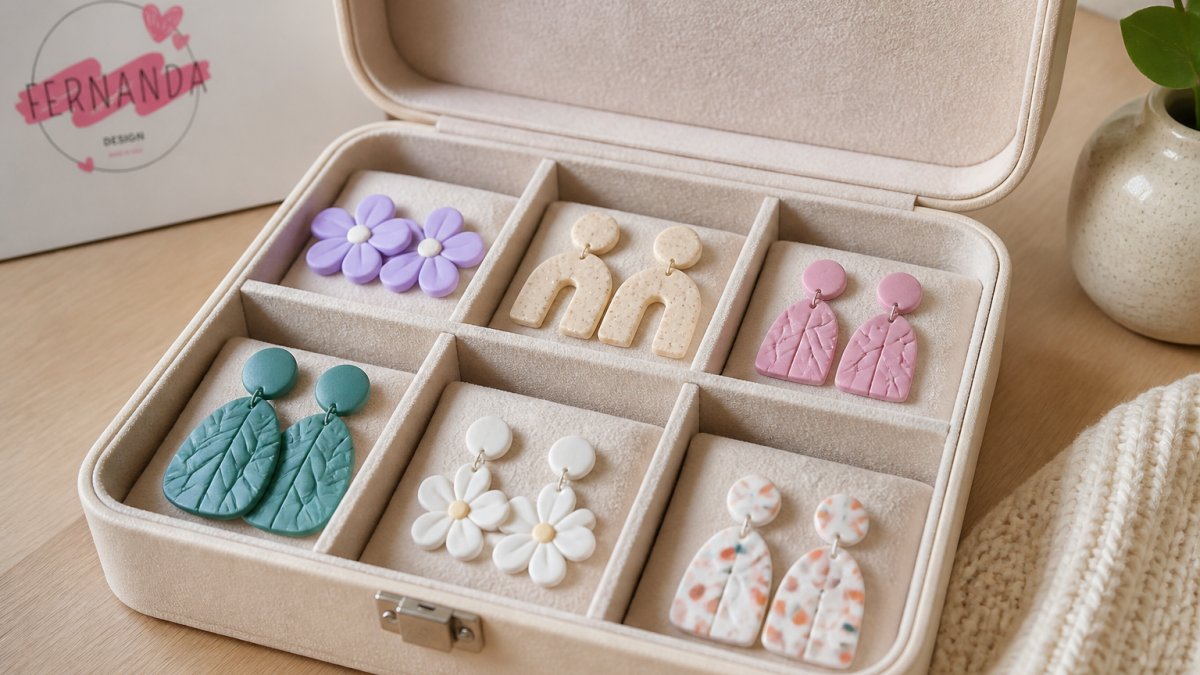
Store earrings in a cool, dry place away from direct sunlight. Use a jewelry box with soft compartments or small pouches lined with soft fabric, keeping each earring separated to prevent scratches and stress on attachment points.
Avoid humid environments like bathrooms and heat sources. Store in a bedroom closet or drawer with stable temperature to prevent clay expansion and contraction that creates micro-cracks.
Repairing Broken or Damaged Clay Earrings
Polymer clay earrings can be repaired, but success depends on the type and location of damage. Understanding your repair options helps you decide whether to fix a piece or retire it.
Repairing Cracks in the Clay
For hairline cracks (barely visible):
- Clean the cracked area with a soft, dry cloth to remove dust or debris.
- Inspect the crack under good lighting. If it's only on the surface and doesn't go through the entire earring, it's a good candidate for repair.
For deep cracks (going through the earring):
Deep structural cracks that split the earring into pieces are difficult to repair invisibly. The repair will be visible and may not hold under stress. Consider whether the earring is worth the effort:
- If it's a sentimental piece or part of a matched set, repair is worthwhile.
- If it's a standard design you can replace, retirement is often the better choice.
Fixing Loose or Detached Hardware
The most common failure point in handmade earrings is where the post (the part that goes through your ear) connects to the clay. Loose posts or detached findings are fixable.
For a wobbly post:
- Inspect the connection point where the post meets the clay. If the post moves side to side, the attachment is loose.
- If the clay around the post is intact but the post is loose, the issue is usually that the post wasn't inserted deeply enough or the clay wasn't fully cured around it.
For a completely detached post:
Replacing Earring Posts and Findings
If the original post or finding is damaged beyond reuse, replacement is straightforward and inexpensive.
Standard replacement posts: Hypoallergenic surgical steel posts are the best choice for durability and skin safety. They cost $2-8 per pair and are available at craft stores or online.
Clip-on or screw-back findings: If you prefer non-pierced earrings, you can replace standard posts with clip-on or screw-back findings. These attach the same way, press into the clay and bake to secure.
Hooks or dangles: If the original earring used a hook or dangle finding, you can replace it with a new one of the same style. Remove the old finding, clean the attachment point, insert the new finding, and bake briefly to secure.
When Repair Isn't Worth It
Some damage is too extensive to repair:
- Large chunks missing: If more than 20-30% of the earring is broken off, the repair will be structurally weak and cosmetically obvious.
- Multiple cracks: Earrings with several cracks in different areas are likely to fail again soon, even after repair.
- Shattered or splintered clay: If the clay has shattered into fragments, it cannot be reliably reassembled.
- Damaged attachment points with structural cracks: If the post area is cracked and the crack extends into the main body, the repair may not hold under the stress of wearing the earring.
In these cases, retiring the earring is the practical choice. You can repurpose the remaining clay for a new project or keep the piece as a keepsake.
Prevention Is Easier Than Repair
The best approach is to avoid damage in the first place:
- Handle earrings gently when putting them on and taking them off.
- Store them in a protective case or soft pouch to prevent impact.
- Avoid dropping earrings on hard surfaces.
- Don't expose earrings to extreme temperature changes, which can cause the clay to expand and contract, creating micro-cracks.
- Remove earrings before swimming, showering, or exercising if you're concerned about impact or moisture exposure.
Quality handmade earrings made with proper baking and durable design rarely need repair.
Practical Durability Testing and Real-World Wear
Customers report that Fernanda Design pieces like Magenta Royale and Sapphire Luxe hold up beautifully to daily wear.

When you're evaluating handmade clay earrings, look for these signs of quality:
- Smooth, even finish with no rough spots
- Secure attachment of hardware with no wobbling
- Appropriate thickness (not too thin or flimsy)
- Even color throughout the design
- Proper weight distribution so earrings hang straight
Handmade clay earrings are genuinely durable wearable art that can last for years when made with quality materials and proper techniques, then cared for appropriately.
At Fernanda Design, we prioritize durability in every piece, crafting handmade clay earrings with the same attention to detail as fine jewelry, designed for real, everyday wear.
Frequently Asked Questions
Can you wear handmade clay earrings every day?
Yes, handmade polymer clay earrings can be worn daily if they're properly baked and well-constructed. Polymer clay, when conditioned correctly and baked at the right temperature, becomes hard and flexible enough for regular wear. The key is gentle handling when putting them on and taking them off, and avoiding prolonged water exposure. Quality handmade earrings with secure findings and reinforced attachment points hold up better to daily use than poorly made pieces.
Do clay earrings break easily?
Polymer clay earrings are not fragile if made correctly, but they can crack or break under stress. Dropping them, bending the clay excessively, or exposing them to extreme temperature changes increases breakage risk. Air-dry clay is more fragile than properly baked polymer clay. Handmade earrings from quality makers use thicker clay, reinforce weak points, and apply protective coatings to reduce cracking. Proper storage and gentle handling make a significant difference in preventing breaks.
How long do polymer clay earrings typically last?
Well-made polymer clay earrings can last for years with proper care. Lifespan depends on baking quality, clay thickness, design complexity, and how often you wear them. Lighter use extends durability significantly. Environmental factors like heat, moisture, and perfume exposure can shorten lifespan. Regular cleaning and storage in a dry place help maximize longevity.
Are polymer clay earrings waterproof?
Polymer clay earrings are not fully waterproof, though they can handle brief water exposure. The biggest risk comes from the findings and attachment points, which can rust or corrode if repeatedly wet. Store clay earrings away from humidity and remove them before bathing. This simple precaution significantly extends their lifespan.
Handmade clay earrings deserve a place in your regular rotation. They're lightweight enough for all-day comfort and durable enough to handle daily life. With basic care and proper storage, your favorite Fernanda Design earrings will remain vibrant and strong for years to come. Shop our collection and discover handmade pieces that elevate your everyday style.