

Are Artisan Lifestyle Products for Home Decor Worth It?
Last Updated: November 4, 2026
Quick Summary
Artisan lifestyle products for home decor are worth it when you choose pieces you use daily, since handmade objects add texture and depth that mass-produced decor cannot match. Start with one piece for the surface you use most and test it for under $30.
- Choose handmade home accessories for use frequency, not display, so the pieces you touch daily change how a room feels.
- Stylists suggest an accent piece occupy roughly one-third to one-half the width of its surface.
- Layer groups of three in odd numbers but vary the heights to create a triangle.
- Mix one handmade piece with two mass-produced ones so a shelf looks lived-in, not like a showroom.
- Small accessories and desk objects typically cost roughly $10 to $40 in the artisan market.
Table of Contents
- Why Artisan Home Decor Changes How a Room Feels
- Handmade Home Accessories That Earn Their Place
- Handcrafted Home Decor Ideas for Every Room
- How to Verify Ethical Home Decor Claims
- Artisan Gifts That Feel Personal, Not Generic
- What Artisan Pieces Actually Cost and Why
- Caring for Handmade Pieces So They Last
- Shop Fernanda Design for Pieces Made in Small Batches
- Frequently Asked Questions
Why Artisan Home Decor Changes How a Room Feels
Artisan lifestyle products for home decor are handmade or small-batch decorative and functional pieces made by individual craftspeople, rather than mass-produced in factories.
That difference is structural, not sentimental. A hand-thrown planter has a slightly uneven rim; a handwoven throw has visible slubs. Those imperfections give a room visual depth machine-finished objects cannot match, which is why artisan lifestyle products for home decor keep showing up in design-led interiors.
Handmade Home Accessories That Earn Their Place
The test for any handmade home accessory is simple: does it do a job while also looking good doing it?
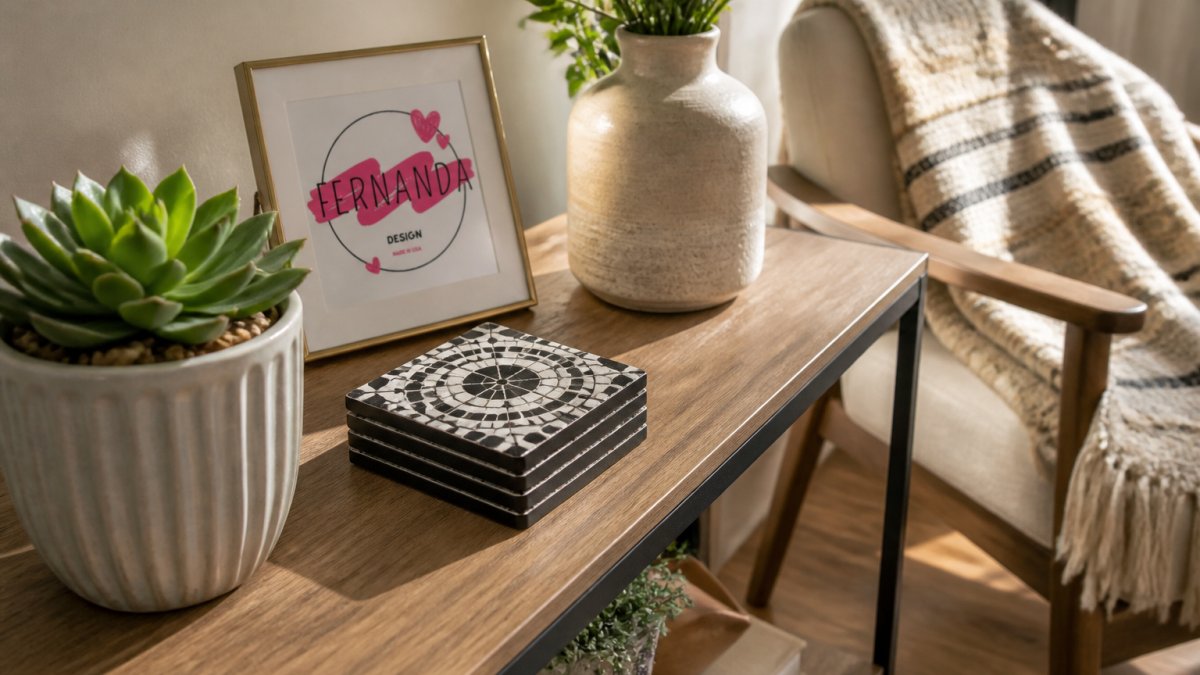
Functional decor is where artisan pieces shine. A set of Black Mosaic Coasters protects a coffee table and adds contrast at the same time, with four round coasters and a matching holder in a black-and-white mosaic pattern that suits modern, minimal, and neutral rooms.

The same logic applies to smaller items: a phone stand, glasses tray, or pen holder solves a daily annoyance while adding texture and color to a surface.
What most guides miss is that handmade home accessories should be chosen for use frequency, not display.
Handcrafted Home Decor Ideas for Every Room
The best handcrafted home decor ideas start with how a room is used, then add one artisan piece per zone. Styling works when each object has a purpose and a place, not when a shelf is crowded.
The four rules that make artisan styling work
Scale to the surface. Stylists generally suggest an accent piece occupy roughly one-third to one-half the width of its surface.
Pull one color from the room. Choose the artisan piece to repeat a color already present in the rug, artwork, or upholstery, then let its texture do the contrast work.
Layer in odd numbers, but not the same height. Groups of three read better than pairs because the eye gets a center and two anchors. Vary the heights: a tall planter, a mid-height tray, and a low coaster stack create a triangle.
Mix one handmade piece with two mass-produced ones. A handmade planter next to a stack of paperback books and a store-bought lamp looks lived-in; a shelf of only handmade pieces can look like a showroom display.
Living room and entryway
Start where guests land. A Cozy Planter with its soft ribbed design and included succulent works on a console, a shelf, or a window ledge, and the clean shape blends into minimalist or cozy rooms alike.

On a coffee table, the Black Mosaic Coasters do double duty: they protect the finish and give the eye a dark anchor in a light room.
Watch out: buying three accent pieces for one small surface is the most common styling mistake. One good object reads as intentional; three crowded ones read as clutter.
Desk, vanity, and bedside
Small surfaces are where artisan pieces earn their keep. The Bubble Pop Organizer holds pens, brushes, or makeup tools in a bright aqua bubble design for $22.99. The Cat Glasses Holder Tray keeps glasses, keys, or jewelry in one spot for $12.99. The Heart Loop Phone Stand does the same for your phone at $12.99.
On a desk, function comes first, and the artisan piece should be the thing you touch most. Put the organizer at the back corner where your hand naturally reaches, keep the phone stand within arm's length of the keyboard, and leave a few inches of clear surface between objects.
On a bedside table, scale is the whole game. A 12-inch-wide table fits a lamp, one small tray, and a phone stand, and nothing else. If the tray and stand compete for the same spot, keep the one you use at night.
Mixing artisan pieces with different design styles
Artisan work is not a style of its own; it is a texture layer that sits on top of whatever style the room already has. The mixing rules differ by style:
- Minimalist and modern rooms: one handmade piece per sightline, in matte, low-contrast finishes. A ribbed neutral planter fits; a high-gloss, multicolor piece fights the room.
- Traditional and transitional rooms: pair handmade pieces with wood and brass, and let pattern carry the interest. A mosaic coaster set works because the pattern echoes the room's textiles.
- Coastal and casual rooms: choose visible weave, slub, or hand-thrown irregularity, and repeat natural materials at least twice so the handmade piece does not look stranded.
A simple test before you commit: photograph the surface from the doorway. If your eye lands on one object first and then travels to the others, it works. If everything competes at once, remove one piece.
For a deeper room-by-room walkthrough, our guide on how to choose everyday essential home decor items covers the selection process in detail.
How to Verify Ethical Home Decor Claims
Ethical home decor means the piece was made by a real person under fair conditions, with materials and processes the seller can actually describe.
Ask these questions before you buy:
- Can the seller name the maker or the workshop?
- Does the listing describe the material and how the piece is made?
- Are there real photos of the production process, not just styled product shots?
A maker with a real story answers these without prompting. A reseller with a nice narrative usually cannot.
The Federal Trade Commission's guidance on "Made in USA" claims sets the standard for country-of-origin labeling, which is a useful benchmark when a shop claims domestic production.
Artisan Gifts That Feel Personal, Not Generic
Artisan gifts work because they carry a decision the giver made. A mass-produced candle says "I stopped at a store." A handmade piece says "I thought about you."
The Mom Love You Decorative Sign is a good example: a tabletop piece with bold lettering and a "love you" detail, priced at $21.99, made for Mother's Day, birthdays, or no occasion at all. The Custom Name Letter goes further, made to order with a chosen initial, name, and color for $27.99, sized at roughly 15 x 20 cm for shelves, desks, and nursery displays.

For more options, our collection of unique artisan gifts and handcrafted ideas covers housewarmings, new babies, and hard-to-shop-for friends.
Best for: anyone who wants a gift with a name or a story attached. Skip if: the recipient prefers purely practical gifts with no display element.
What Artisan Pieces Actually Cost and Why
Artisan home decor often costs more than factory-made equivalents because handmade work takes more time per piece.
That explanation is where most guides stop. The useful version is a set of price bands you can compare against, a way to judge whether a piece is worth its price, and an honest look at when the math does not work in artisan favor.
Typical price bands for artisan home decor
Prices vary by material, technique, and maker scale, but a common pattern in the market looks like this:
- Small accessories and desk objects (trays, phone stands, organizers, coasters): roughly $10 to $40. At this level you are paying mostly for design and finishing time, not raw material.
- Ceramics and planters: roughly $20 to $80 for small and mid-size pieces, with hand-thrown and glazed work at the upper end. Large statement vessels can run well past $100.
- Textiles (throws, pillows, table linens): roughly $40 to $200, with handwoven and naturally dyed pieces at the top of the range.
These are ranges, not rules. The point is to give you a reference so a $12 coaster set and a $29 coaster set can be compared on something other than gut feel.
How to judge whether a piece is worth its price
Four factors separate a fair price from an inflated one:
Time per unit. A piece that takes two hours to make and sells for $30 pays the maker about $15 an hour before materials, below what most independent makers need. Ask how long a piece takes to make; makers who work by hand usually know.
Material cost and sourcing. Small-batch makers buy clay, yarn, glass, and hardware in small quantities, which raises unit cost. A planter made from a $2 imported pot and repainted is not the same product as a hand-thrown one, even at the same price.
Batch size. Limited runs spread setup time across fewer units. A piece from a run of 20 carries more per-unit labor than one from a run of 2,000, and that difference shows up in the price.
A value comparison you can run before buying
Compare any two pieces on four lines:
- Price per year of expected use. Divide the price by how many years you expect to keep the piece; a higher sticker price can still be the cheaper object over time.
- Price per function. A $12.99 phone stand used daily for years is a different value than a $12.99 decorative object that sits untouched.
- Resale and gifting value. Handmade pieces with a maker's name hold gifting value generic imports do not; a personalized piece is rarely resold, which is part of its point.
- Hidden costs. Shipping, personalization fees, and return shipping on made-to-order items can add $5 to $20. Factor them in before comparing.
Our own range, for reference
Here is how our own range is priced:
| Piece | Price | Best For | Why It Earns the Price |
|---|---|---|---|
| Heart Loop Phone Stand | $12.99 | Bedside, desk | Daily use, decorative shape |
| Cat Glasses Holder Tray | $12.99 | Entryway, vanity | Organizes glasses and keys |
| Butterfly Bliss Phone Stand | $14.99 | Aesthetic workspaces | Cutout wing detail |
| Mom Love You Decorative Sign | $21.99 | Gifting | Sentimental, display-ready |
| Bubble Pop Organizer | $22.99 | Craft room, office | Holds brushes and tools |
| Cozy Planter | $24.99 | Shelves, windows | Succulent included |
| Custom Name Letter | $27.99 | Nurseries, gifts | Made to order |
| Black Mosaic Coasters | $29.99 | Coffee table, bar cart | Set of four with holder |
When artisan pieces are not the right buy
The honest limitation: artisan pieces are not the cheapest way to furnish a room. If budget is the only factor, mass-produced wins. If you need 12 identical items for a large event, handmade production may not scale.
For everything else, the math changes: you are buying objects you keep for years, and the per-year cost often beats the cheaper alternative.
Caring for Handmade Pieces So They Last
Handmade pieces last when you match care to material, not when you treat everything the same way. A few rules cover most of what we sell.
- 3D-printed pieces like our phone stands and organizers: wipe with a damp cloth, keep out of direct sun, and avoid leaving them in a hot car.
- Coasters and trays: wipe clean and dry the base promptly so moisture does not sit under the piece.
- Planters: water the succulent sparingly and empty any standing water from the base.
Shop Fernanda Design for Pieces Made in Small Batches
If you have been burned by "artisan" listings that turned out to be resold imports, the check is the maker. The Custom Name Letter is the clearest example: it is made to order with a chosen initial, name, and color for $27.99.
Start with one piece for the surface you use most, live with it for a month, and see whether the room feels different.
Frequently Asked Questions
What counts as artisan-made home decor?
Artisan-made home decor is designed and produced by an individual maker or small studio rather than a factory line. That usually means hand shaping, hand finishing, or small-batch production, so pieces vary slightly from one to the next. Materials like clay, glass, metal, and textiles are common. The tell is inconsistency in the good sense: tiny differences in glaze, weave, or edge that a machine would never produce.
How can you tell whether a home decor item is actually handmade?
Ask three questions before you buy. Who made it, where, and how? A real maker answers all three without hedging. Look for close-up photos of the piece, a named studio or artist, and details about the process. Watch for listings that use the word artisan but show identical stock photos across dozens of unrelated products. Fernanda Design, for example, describes its pieces as handmade in Texas, which is the kind of specific claim you can check.
Are artisan lifestyle products for home decor worth the price?
They often cost more because handmade work takes more time per piece. A $24.99 Cozy Planter or a $29.99 coaster set reflects that handwork, not just materials. The value question is longevity and uniqueness: a piece you keep for years and actually display costs less per use than three trend items you replace. If a piece solves a real need in your space, the premium is usually justified.
What artisan home decor makes a thoughtful gift?
Pick something the recipient will use or display daily. A Custom Name Letter at $27.99 works for a nursery, dorm, or birthday because it is made to order with a chosen name, initial, and color. A Mom Love You Decorative Sign at $21.99 suits Mother's Day or a birthday. Practical pieces like the Cat Glasses Holder Tray at $12.99 land well with cat lovers because they are decorative and functional at once.
How do you choose handmade home decor that fits your style?
Start with the room, not the product. Note the dominant colors and the materials already there, then choose one artisan piece that repeats a color or adds a texture you are missing. A black-and-white coaster set fits modern and neutral rooms; a bright aqua organizer suits creative spaces. Buy one statement piece first, live with it for a week, and add from there rather than filling a shelf all at once.
Ready to add a piece with a story? Browse the Fernanda Design collection, start with a planter or a coaster set, and give one corner of your home the kind of detail that mass-produced decor cannot copy.
