

Buy Artisan Polymer Clay Earrings Online: 2026 Guide
Table of Contents
- Why Buy Artisan Polymer Clay Earrings Online
- Material Quality: Polymer Clay, Findings, and Durability
- Hypoallergenic Earring Materials for Sensitive Skin
- Styling Handmade Statement Earrings for Every Face Shape
- How to Clean Polymer Clay Earrings and Keep Them Looking New
- Pricing, Customization, and Gift Ideas: What to Expect
- Frequently Asked Questions
Last Updated: September 27, 2026
Why Buy Artisan Polymer Clay Earrings Online
When you buy artisan polymer clay earrings online, you're choosing jewelry made by hand rather than pulled off a factory line. This guide from Fernanda Design covers what separates genuine artisan work from mass-produced pieces, how to judge material quality, and how to style and care for handmade earrings.
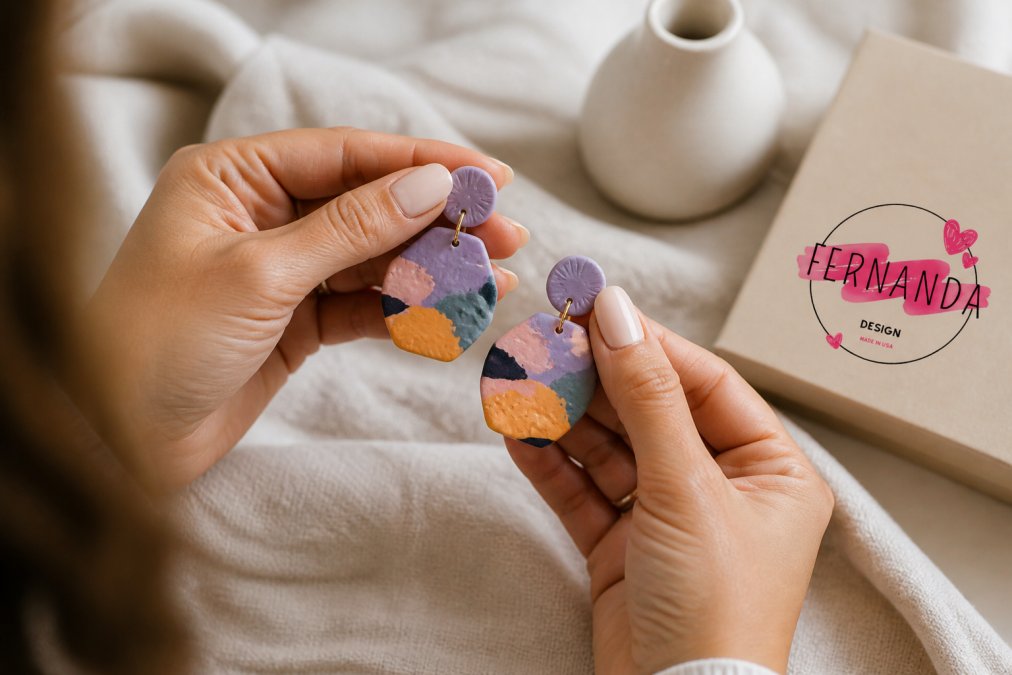
Handcrafted Design Process and Small Batch Production
Artisan earrings start as raw clay blocks that get conditioned, rolled flat, cut into organic shapes, textured, and cured in a low-temperature oven, then assembled by hand with jump rings and findings.
How to Spot Genuine Artisan Work vs Dropshipped Resellers
The clearest tell is consistency. Genuine artisan work shows slight variation between pairs because a human made each one; dropshipped pieces arrive identical, sealed in generic plastic, with no maker story.
Ask yourself three questions before buying:
- Does the shop show process photos or videos of the work being made?
- Can the seller explain their materials and curing method?
- Do reviews mention weight, finish, and comfort, or just "fast shipping"?
Material Quality: Polymer Clay, Findings, and Durability
Durability comes down to two things: how the clay was cured and what metal the findings are made from. Get both right and a pair can last years.
Clay Machine, Texture Roller, and the Curing Process
A clay machine (also called a pasta machine) rolls clay to an even thickness, which prevents weak spots. A texture roller presses patterns into the surface before curing.
Jump Rings, Stainless Steel, and Gold-Plated Hardware
Jump rings connect the clay piece to the ear wire. Stainless steel findings resist tarnishing and hold up to daily wear, while gold-plated hardware offers a warmer look, though plating can wear with heavy use.
Hypoallergenic Earring Materials for Sensitive Skin
Hypoallergenic earring materials are metals and finishes formulated to reduce allergic reactions, most commonly nickel-free stainless steel, gold plating over a safe base metal, and surgical-grade options. If your ears react to cheap earrings, the culprit is usually nickel (Nickel Allergy and Piercings: A Systematic Review and Meta-Analysis).
Styling Handmade Statement Earrings for Every Face Shape
Styling handmade statement earrings comes down to proportion, not rules: balance your face's natural width and length so the earring flatters instead of overwhelming. To judge proportion before you buy, hold a photo of the earring next to a photo of your face at the same scale. If the earring's longest dimension exceeds the distance from your earlobe to the bottom of your chin, it reads as a statement piece; if it's shorter than the distance from your earlobe to your jawline, it reads as everyday wear.
Here's how that plays out by face shape:
- Round faces: choose long dangle earrings with angular or geometric shapes to add vertical length. The ZigZag Clash, with its asymmetrical geometric design, works well here because the sharp angles contrast a soft jawline.
- Oval faces: most shapes suit you, so experiment with color and texture rather than silhouette.
- Square faces: soft, organic shapes and rounded hoops balance a strong jawline. The Julisse, with its soft-edged organic shape and metallic hoop, fits this because the curve softens angular features.
- Heart-shaped faces: wider bottoms like teardrops and hoops add balance below the cheekbones, where the face is narrowest.
- Long faces: wide, horizontal statement pieces or clustered studs add width. Avoid long, narrow dangles, which stretch the face further.
Statement vs. Minimalist: Matching Earrings to Your Outfit
Statement earrings are the focal point of an outfit; minimalist earrings support it. A working rule: if your outfit already has a strong pattern, bold color, or dramatic silhouette, go minimal with the earrings. If your outfit is simple, let the earrings carry the look.

Weight and Comfort: What All-Day Wear Really Feels Like
Polymer clay is one of the lightest jewelry materials available, which is why artisan makers favor it for statement designs. A large clay earring often weighs less than a small metal one, a typical pair of clay statement dangles weighs roughly the same as two or three standard metal studs, depending on size and findings.
Three comfort factors to check before buying:
- Hook style: fishhook and lever-back styles distribute weight differently. Lever-backs hold the earring closer to the lobe, which reduces swing and pull.
- Jump ring placement: a jump ring attached at the top of the clay piece keeps the earring hanging straight. A ring attached off-center can cause the piece to tilt and feel heavier than it is.
- Clay thickness: thinner clay is lighter but warps; thicker clay holds shape but adds weight. A middle thickness works best for daily wear.
How to Clean Polymer Clay Earrings and Keep Them Looking New
To clean polymer clay earrings, wipe them with a soft, slightly damp cloth and mild soap, then dry immediately. Avoid alcohol, acetone, and harsh cleaners, which dull the finish and damage the clay.
A few habits keep handmade jewelry looking new:
- Store earrings flat or hanging, away from direct sunlight
- Put earrings on last and take them off first to avoid perfume and hairspray
- Keep them away from lotions and oils
- Wipe after each wear to remove skin oils
Cleaning and Restoration Tips for Dull or Scuffed Clay
A matte finish can often be revived with a tiny drop of mineral oil buffed in with a soft cloth. Light scuffs sometimes smooth out with gentle finger pressure and warmth, since polymer clay stays slightly flexible.
Pricing, Customization, and Gift Ideas: What to Expect
Artisan polymer clay earrings typically sit in an accessible price range, and Fernanda Design's pieces run from $11.99 to $12.99. You pay a little more than mass-market prices for handcrafted design and better hardware, and you get a piece no one else is wearing.
How Artisan Pricing Actually Works
When you buy artisan, you're paying for four things: materials, labor, design time, and overhead. A pair that takes two hours to design, condition, shape, cure, sand, and assemble carries that labor in the price; mass-market earrings spread design and tooling costs across thousands of units, which is why they sell for less.
- Clay quality: non-toxic, phthalate-free clay costs more than budget clay and holds color better over time.
- Hardware: stainless steel and gold-plated findings cost more than nickel-based base metals but resist tarnishing and irritation.
- Finish work: sanding, buffing, and sealing add time but produce a smoother, more durable surface.
- Batch size: smaller batches mean less efficiency, which raises per-unit cost.
Customization and Personalization Options
Customization is where artisan shopping beats retail. Many makers offer custom colorways and specific design requests. The most common requests are:
- Color matching: sending a photo of an outfit or wedding palette and asking the maker to match it.
- Size adjustments: shortening a dangle or making a stud version of a dangle design.
- Hardware swaps: choosing gold-plated or stainless steel findings to match other jewelry.
- Bridal and event sets: multiple pairs in a coordinated palette for a wedding party.
Gift-Ready Packaging and Presentation
If you're buying as a gift, a one-of-a-kind piece in the recipient's favorite color lands better than anything off a shelf. Gift-friendly picks from the collection:
- Lilac Starfish ($12.99): a coastal-inspired silhouette in soft lilac, ideal for summer birthdays
- Lumin ($11.99): a pearly, organic shape with golden hoops for a subtle, sophisticated look
- Julisse ($11.99): playful and modern, good for someone who likes bold color
Eco-Friendly Materials and Ethical Sourcing
Eco-friendly jewelry means materials chosen with lower environmental impact and traceable sourcing. Polymer clay is synthetic, but it's durable and long-lasting, which reduces the throwaway cycle of cheap fashion jewelry, a pair that lasts five years replaces dozens of disposable pairs.

| What You're Comparing | Mass-Market Earrings | Artisan Polymer Clay Earrings |
|---|---|---|
| Production | Factory, high volume | Handmade, small batch |
| Hardware | Often nickel-based | Hypoallergenic, nickel-free options |
| Weight | Varies, often heavier | Lightweight clay |
| Uniqueness | Identical repeats | One-of-a-kind designs |
| Price | Lowest | $11.99-$12.99 at Fernanda Design |
Frequently Asked Questions
How can you tell if polymer clay earrings are high quality?
Look for smooth, even edges, consistent color throughout the piece, and a glossy or matte finish without bubbles or cracks. Quality artisan polymer clay earrings are cured properly, which means they hold their shape and resist chipping. Check the hardware too: stainless steel or gold-plated findings with secure jump rings signal better construction. A maker who shares their handcrafted design process and small batch approach is usually a reliable sign of genuine artisan work.
Are polymer clay earrings durable enough for everyday wear?
Yes, when they are made and cured correctly. Polymer clay is flexible and lightweight, so it bends slightly under pressure instead of snapping. Handcrafted pieces from small batch makers tend to last longer because each pair is inspected individually. To extend their life, store them flat, avoid pulling on the jump rings, and keep them away from extreme heat. With basic care, a well-made pair can stay vibrant for years.
Are polymer clay earrings hypoallergenic?
The clay itself is generally non-reactive, but the metal findings are what usually cause irritation. Hypoallergenic earring materials like stainless steel, nickel-free alloys, and gold-plated posts reduce the risk for sensitive skin. If you have known metal allergies, ask the maker directly what hardware they use. Many artisan sellers list this detail on each product page, and it is a fair question to ask before you buy artisan polymer clay earrings online.
How should I care for my polymer clay earrings?
Wipe them with a soft, damp cloth after wearing to remove oils and makeup. For deeper cleaning, use a small amount of mild soap and water, then dry immediately. Avoid alcohol, acetone, and household cleaners, which can dull the finish. Store earrings in a pouch or flat box so they do not scratch against other jewelry. Keep them out of direct sunlight and hot cars, since prolonged heat can soften the clay over time.
What are the benefits of buying artisan-made jewelry?
Artisan jewelry gives you a one-of-a-kind piece rather than a mass-produced duplicate. You are supporting a real maker, often working in small batches with attention to detail that factory lines cannot match. The materials tend to be chosen more carefully, and the designs carry a personal story. For gift ideas, an artisan piece feels more thoughtful because no one else will show up wearing the same earrings.
How do I know the colors will match what I see on my screen?
Screens vary, so slight differences between the photo and the physical piece are normal. Look for listings that show multiple angles and natural lighting, since those give the most accurate representation. If a shade matters for a gift, message the maker and ask for a real-life photo. Reputable artisan sellers are happy to confirm the exact color before shipping, which removes most of the guesswork from ordering online.